1:1 Mirror Replica Watches: What the Grade Actually Means

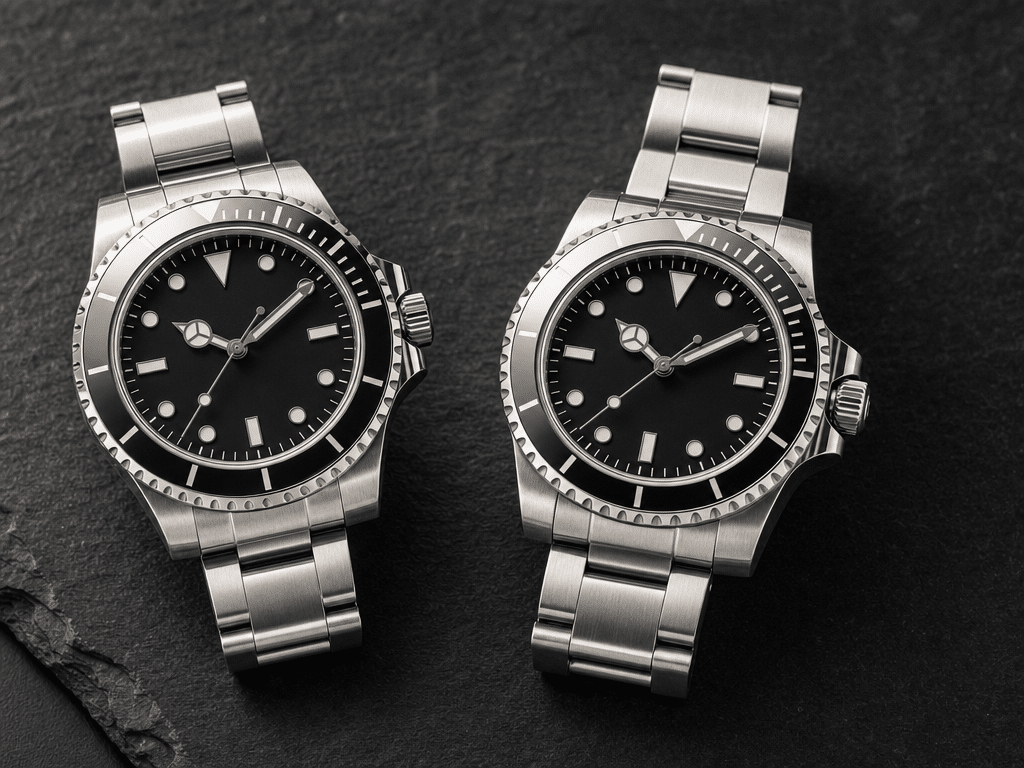
Last updated: August 2026
Every listing in this market claims to be a 1:1 mirror replica. Almost none of them are. The phrase has been stretched so far that it now appears on watches costing thirty dollars and on watches costing eight hundred, which makes it useless as a signal unless you know what it is supposed to describe. This guide sets out what a 1:1 mirror replica watch actually is, the eleven things that have to match before the term is honest, which makers reach that level, and how to test a seller’s claim before any money leaves your account.
What is a 1:1 mirror replica watch?
A 1:1 mirror replica is a watch built to reproduce a specific reference of a specific original, dimension for dimension, using a cloned copy of the original mechanical movement rather than a generic automatic dressed up to look the part. The two halves of the phrase carry different meanings and both matter.
- 1:1 refers to scale and specification. The case diameter, the lug to lug length, the thickness, the lug width, and the weight are meant to match the original rather than approximate it.
- Mirror refers to the visual result. Placed beside the genuine article, the copy should mirror it closely enough to survive a careful, unhurried look rather than only a glance across a room.
Put plainly, a 1:1 mirror replica is not a watch that resembles the original. It is a watch that attempts to behave like it. That is why the movement sits at the centre of the definition and why any listing that will not name the caliber has already told you what you need to know.
Where the word “mirror” came from
The term grew out of forum shorthand rather than any official standard. Buyers needed a way to separate the small number of watches that could withstand close comparison from the mass of pieces that could not, and mirror described the experience of holding the copy next to the original and seeing the same thing twice. Nobody polices the phrase, no body certifies it, and no factory is audited against it. It remains useful only as a description of a level of work, which is why the checklist further down matters more than the label itself.
The single most useful thing to understand. Mirror is a description of quality, not a brand and not a certification. When a seller writes 1:1 mirror in a title, they have made a claim. The rest of this page is how you test it.
The grade ladder, from fashion fake to 1:1 mirror
Understanding where mirror sits relative to everything else below it removes most of the confusion in this market.
| Grade | Movement | Typical price | Survives a close look? |
|---|---|---|---|
| Fashion or street fake | Quartz or basic automatic | Under 100 USD | No, obvious at arm’s length |
| AAA grade | Generic automatic | 100 to 250 USD | No, wrong weight and printing |
| Super clone | Cloned caliber | 350 to 700 USD | Usually yes |
| 1:1 mirror | Cloned caliber, best available build | 500 to 1,200 USD and up | Yes, including under a loupe on most details |
The important boundary is between AAA and super clone, because that is where the movement stops being generic. Mirror sits at the top of the super clone band rather than forming a separate category with its own technology. A mirror piece is a super clone where the factory got everything right at once on a reference it knows well.
The eleven things that must match
This is the working checklist. A watch that fails several of these is not a mirror replica whatever the listing says.
1. The movement
A cloned caliber that reproduces the original’s winding action, hacking seconds, beat rate, and power reserve behaviour. This is the most expensive thing to get right and the first thing a weak build compromises. If the seller cannot name the caliber, stop.
2. Case weight
The original is cut from a specified alloy to a consistent standard, which gives it a heft your wrist recognises immediately. A watch that feels light is made from thinner or cheaper metal, and no amount of surface finishing hides it.
3. Case dimensions
Diameter, thickness, lug to lug, and lug width should match the reference to within a fraction of a millimetre. Thickness is the one weaker factories miss most often, because a slightly taller case is the easy way to fit a movement that is not quite right.
4. Finishing transitions
Luxury cases alternate brushed and polished surfaces, and the line where one meets the other should be crisp rather than blurred. Run the case under a strong light and look at the edges of the lugs. Soft transitions are the clearest sign of a lower tier.
5. Dial printing
Under magnification the text should be sharp, evenly spaced, and correctly weighted. Blurred, thick, or unevenly spaced printing is the most common single failure on pieces sold as mirror.
6. Applied markers and hands
Markers should sit level and be seated cleanly, and the hands should be the correct length, with the seconds hand reaching the minute track rather than stopping short of it.
7. The bezel
On a dive reference the bezel should rotate with a firm, even click and no play. Ceramic colour should be consistent across the insert, and any engraving should be crisp with evenly filled markings.
8. The crystal and cyclops
Sapphire with the correct anti reflective treatment. Where a date magnifier is fitted, it should sit centred over the window and magnify to the correct factor, which is a detail cheap copies almost always get wrong.
9. The lume
Application should be even, the colour should be right for the reference, and the glow should be strong and uniform after light exposure rather than patchy or fading within minutes.
10. The bracelet and clasp
Solid links with even gaps, correct taper, and a clasp that closes with a clean action rather than a loose rattle. A hollow feeling bracelet is a reliable sign that the factory cut costs elsewhere too.
11. The rehaut
The inner ring between dial and crystal should be cleanly engraved or printed and correctly aligned with the dial markers. Misalignment here is a fast tell.
What almost never matches, even at mirror level
Honesty about the ceiling is more useful than marketing copy. Even the best pieces in this market differ from the original in ways that are worth knowing before you buy.
- Long term movement finishing. The decoration inside a genuine high end caliber is done to a standard no clone matches, though on most references you will never see it.
- Service life and parts support. There is no manufacturer service network, and a clone caliber will not last decades of servicing the way an original can.
- Certain proprietary details. Some materials and treatments used by the original manufacturers are simply not reproduced.
- Authentication. A watchmaker who opens the case will know. Mirror describes what survives a close visual and tactile inspection, not a bench examination.
Which factories reach 1:1 mirror level
Mirror level output is model specific rather than factory specific. A maker can be the strongest in the market on one reference and mediocre on the next, so the honest question is always which factory is best for the exact watch you want.
- Clean Factory for Rolex sports references.
- VS Factory across the Rolex range and for its movement work.
- 3K Factory and PPF for Patek Philippe, particularly the Nautilus and Aquanaut.
- JF Factory for the Audemars Piguet Royal Oak and Panerai.
- ZF Factory across several brands.
- VR for the cloned Rolex calibers that other assemblers build on.
For a direct ranking of which maker currently leads on which reference, see our guide to which factories make the best super clone watches. This page defines the grade. That page names the winners.
Which references exist at mirror level
The strongest work concentrates on the references that are hardest to obtain at retail and therefore most in demand, which is why the steel sports models dominate.
- Rolex Submariner, the most reproduced reference in the market.
- Rolex Daytona, where the chronograph makes the movement question decisive.
- Rolex GMT Master II, including the two tone bezel variants.
- Audemars Piguet Royal Oak, where the tapisserie dial and case finishing separate the tiers.
- Patek Philippe Nautilus and the Aquanaut.
- Richard Mille, where case architecture rather than dial printing is the challenge.
How to verify a 1:1 mirror claim before you pay
Five questions separate a documented seller from a listing. None of them require expertise to ask.
- Which factory built it? A seller operating in the open answers immediately.
- Which caliber is inside? The name of the movement, not the phrase automatic movement.
- Can I see QC photographs of the exact watch? Photographs of your piece before it ships, not stock images and not a different example of the same model.
- What are the case dimensions? Compare them against the published figures for the genuine reference. A mismatch in thickness is the usual tell.
- What payment methods do you accept? A reversible method should be available. Pressure toward an irreversible one is the end of the conversation.
How much does a 1:1 mirror replica cost?
Expect roughly 500 to 1,200 US dollars, rising with the complexity of the movement and the case material. A chronograph costs more than a three hand watch because the movement is harder. Gold wrapped cases cost more than steel because the material is real rather than plated.
Price is also the fastest filter in this market. A watch advertised as 1:1 mirror at 150 dollars is an AAA piece wearing the words, because the cloned movement alone costs more than the asking price. The unusually cheap listing is a signal, not a bargain.
Where to buy
Buy from a seller who curates rather than one who lists everything, and who documents the factory and the caliber for each piece instead of hiding behind the grade name. Reverie stocks the upper tier of factory output, publishes the movement and reference for every watch, sends QC photographs of your exact piece before shipping, and ships tracked worldwide. Message us to ask which factory currently makes the best version of the reference you want.
Frequently asked questions
What does 1:1 mirror replica mean?
A watch built to match a specific reference dimension for dimension, using a cloned copy of the original movement, and finished well enough to survive a close side by side comparison. It is a description of quality, not a certification.
Is a 1:1 mirror replica the same as a super clone?
Effectively yes. Mirror describes the top of the super clone band rather than a separate technology. Both require a cloned caliber.
What is the difference between 1:1 and AAA?
AAA uses a generic automatic movement and approximate dimensions. A 1:1 mirror piece uses a cloned caliber and matches the reference specification. The price gap is usually three to five times.
How much does a 1:1 mirror replica watch cost?
Generally 500 to 1,200 US dollars depending on movement complexity and case material. Anything near 150 dollars is not one.
Can a jeweller tell a 1:1 mirror replica from the original?
A watchmaker who opens the case will know. Mirror grade describes what survives close visual and tactile inspection, not a bench examination.
Which factory makes the best mirror replicas?
It depends entirely on the reference. Clean leads on Rolex sports models, 3K and PPF on Patek, JF on the Royal Oak. See our factory ranking guide.
How can I check a mirror claim before buying?
Ask which factory and which caliber, request QC photographs of your exact watch, compare the case dimensions against the genuine reference, and use a reversible payment method.
Are mirror replica and mirror copy watches the same thing?
Yes. Mirror copy is simply an alternative phrasing for the same grade, and both are used loosely enough that the checklist above matters more than the wording.